The website We are Numismatics came about as a place where you can stay informed regarding all events related to the world that we are all so passionate about: Numismatics.
About us
We are Numismatics is made up of a team of expert collaborators in Numismatics, History of Art and Heritage Maintenance and Conservation. Coinage is a documentary source in itself, as well as an expression of History. In some cases, it is also a work of art. All in all coinage represents passionate feelings that we would like to share with you. We will keep you punctually informed about any events or research and investigation related to our discipline.
If you have any questions or queries, don´t hesitate to contact us in the Contact section.
Patronage
As you may know, our main interest at We are Numismatics is to promote and increase awareness regarding scientific and cultural numismatic knowledge (publications, congresses, conferences, exhibitions, courses and tours), and compile quality information that is interesting for collectors. Therefore, the support of our patrons is essential. Thanks to their efforts, this website is made possible. We would like to express our most sincere appreciation and gratitude to all of them.
Imperatrix
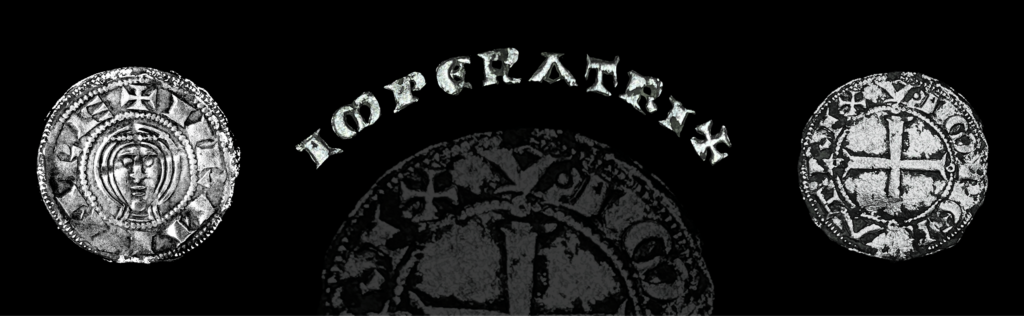
The IMPERATRIX catalog is a literal excerpt from the numismatic catalog contained in Manuel Mozo Monroy´s book entitled “Enciclopedia de la Moneda Medieval Románica, ss. VIII-XIV”, volumes I, II and III” (Encyclopedia of the Romanesque medieval coin in the kingdoms of León and Castilla, ss. VIII-XIV). Thanks to the author, Imperatrix came into being to serve as a useful tool in order to easily identify and classify any Christian medieval coins from the kingdoms of León and Castilla between the VIII and XIV centuries. Researchers, institutions, archaeologists and private collectors will benefit from public access to this catalog. It is presented with the main objective of enriching the scientific outlook on Medieval Numismatics.
This online catalog dates from the first kingdoms, contents which has already been included in the first edition of the Encyclopedia, including addendums with extensions and modifications of coins from the years after publication up to the present.
The completed online catalog dates from Pedro I up to the coining of Princess Isabel and thus chronologically closing the catalog of Christian Medieval Ages of both kingdoms. Therefore, Imperatrix exclusively contains the cataloging part of Manuel Mozo Monroy´s work already mentioned, which will remain the reference for those who wish to have a deeper knowledge of Medieval Numismatics in the history of the kingdoms of León and Castilla.
Due to the evolutionary nature of the investigations, this catalog will be periodically reviewed and updated in order to include new types and numismatic variations discovered or those which have appeared in auctions. From a methodological point of view, future cataloging works will be subjected to a constant process of historiographic and hermeneutic review of sources and bibliography, in order to include coins from archeological discoveries or new coins that may appear , such as from private collections, museum specimens, or coins auctioned by numismatic trademarks.
These revisions will be under the direction of Dr. Ana Serrano PhD in History of Art, specialized in “Methodologies of historiographic research”, a highly experienced professional with extensive experience in numismatic cataloging and management systems for historical heritage such as DOMUS and SIPHA.
Nomeclature:
The nomenclature used to identify each piece is preceded by an abreviated code for the issuer´s name, followed by a number referring to its typology and another number that identifies the variant. Examples:
A7:15.52 would be Type 15, variant 52 from Alfonso VIII
S4:3.2 would be Type 3, variant 2 from Sancho IV
F2(ADD):1.3(50)would be the Addenda from Fernando LL, Type 1, variant 3(50)
Library
The library is a fundamental and basic part of a collector´s cabinet and their books are the precious gems that enrich their collections.
In this section we present the latest news and press releases from our prestigiously renowned collaborators and researchers.
The order form can be found at the bottom of the page.
Please fill out the form bellow if you are interested.
Museion
Some people think that coin collecting began during the Italian Renaissance. However, Suetonius, in his “De Vita Caesarum” (The Twelve Caesars), tells us that the Emperor Augustus was fond of ancient and foreign coins, which he used to give to his friends.
Coin collecting can also be found in the origins of museums. Cabinets of curiosities or Cabinets of wonder, “studiolos”, and “kunst kabinett”, went from being a thing of personal enjoyment to a service for society, to promote studying, education, and developing research pertaining to collectable objects.
Collection exhibits may not always be accessible. However, virtual media offers us dissemination possibilities that were until now unthinkable. This is where we find the value of virtual museums, making those collections that would otherwise not be enjoyed, available to everyone. In addition to that, virtual museums offer us a database with pieces that have already been cataloged, free access to coin pictures, search by different criteria, and even pieces in 3D format.
We here at We are numismatics, have placed value on private collections, and for this reason, we present this virtual museum, giving public access to private collections for all those who value their collections, not only from an personal enjoyment point of view but also to get back to the spirit of Musaeum.
<<Preserve, protect, captivate, investigate and educate>>
Use of images or pictures.
If you wish to receive images included in the Museion, at We are Numismatics, for representation without watermark, for research or non-profitable purposes, don´t hesitate to request them by filling out the Contact form.
How to correctly accredit images
First of all whenever you want to include an image which is not of your own authorship you must insert the picture and correctly accredit it in the text. After, then add the reference to the original source in the footnotes and bibliography.
User conditions:
Personal data gathered on this website when filling out the contact forms are: name, email, phone number, mailing address and any possible comments you may want to make. Take into consideration that your answers in boxes marked with an asterisk are mandatory in order to be able to process a message through this website. When you subscribe to our Newsletter, only your e-mail address is needed.
We will only process or use your personal data, in order to contact you or to send you our Newsletter.
Personal data written on this form is registered in an electronic file managed exclusively by We are Numismatics. We have set up a secure system that guarantees your confidentiality and security of your personal data, in order to avoid any unwanted removals, forbidden accesses, or any other unauthorized or fraudulent use or access by third parties , according with GDPR standards.
We therefore pledge to not sell, rent or transfer your data to third parties, without your prior consent, except in the case that we are required to do so by law.
We are Numismatics, is held accountable under the protection framework regarding personal data established by the European Union regarding use, regulation and retention of data. You have the right to access, ratification, portability and deletion of your personal data, or even, limit data processing concerning you by simply contacting We are Numismatics.
Subscription form
We will keep you informed and up to date regarding events, talks and everything that we publish on our blog.